Categories

Ultimate Guide to EPA Certified Excavators: Tier 4 Performance & ROI Analysis

Explore the engineering excellence and economic advantages of EPA certified excavators. This technical deep dive covers Tier 4 emissions, hydraulic efficiency, fuel savings, and lifecycle ROI for heavy-duty construction and mining applications.
May 26th,2026 74 Views

Introduction: The Compliance Productivity Paradox

Construction and mining operators face mounting pressure: stricter emissions regulations, rising fuel costs, and zero tolerance for downtime. An EPA certified excavator is no longer just a regulatory checkbox—it is a strategic asset. Certified to meet EPA Tier 4 Final (equivalent to EU Stage V) standards, these machines integrate advanced aftertreatment systems without sacrificing hydraulic power or cycle times. Data from field studies show that modern EPA certified excavators achieve up to 12% lower fuel consumption and 15% longer service intervals compared to Tier 3 predecessors, directly lowering total cost of ownership (TCO). This guide dissects the powertrain, durability, and real-world ROI of today’s compliance-ready heavy machinery.

Core Powertrain & Structural Design

Engine & Aftertreatment Integration

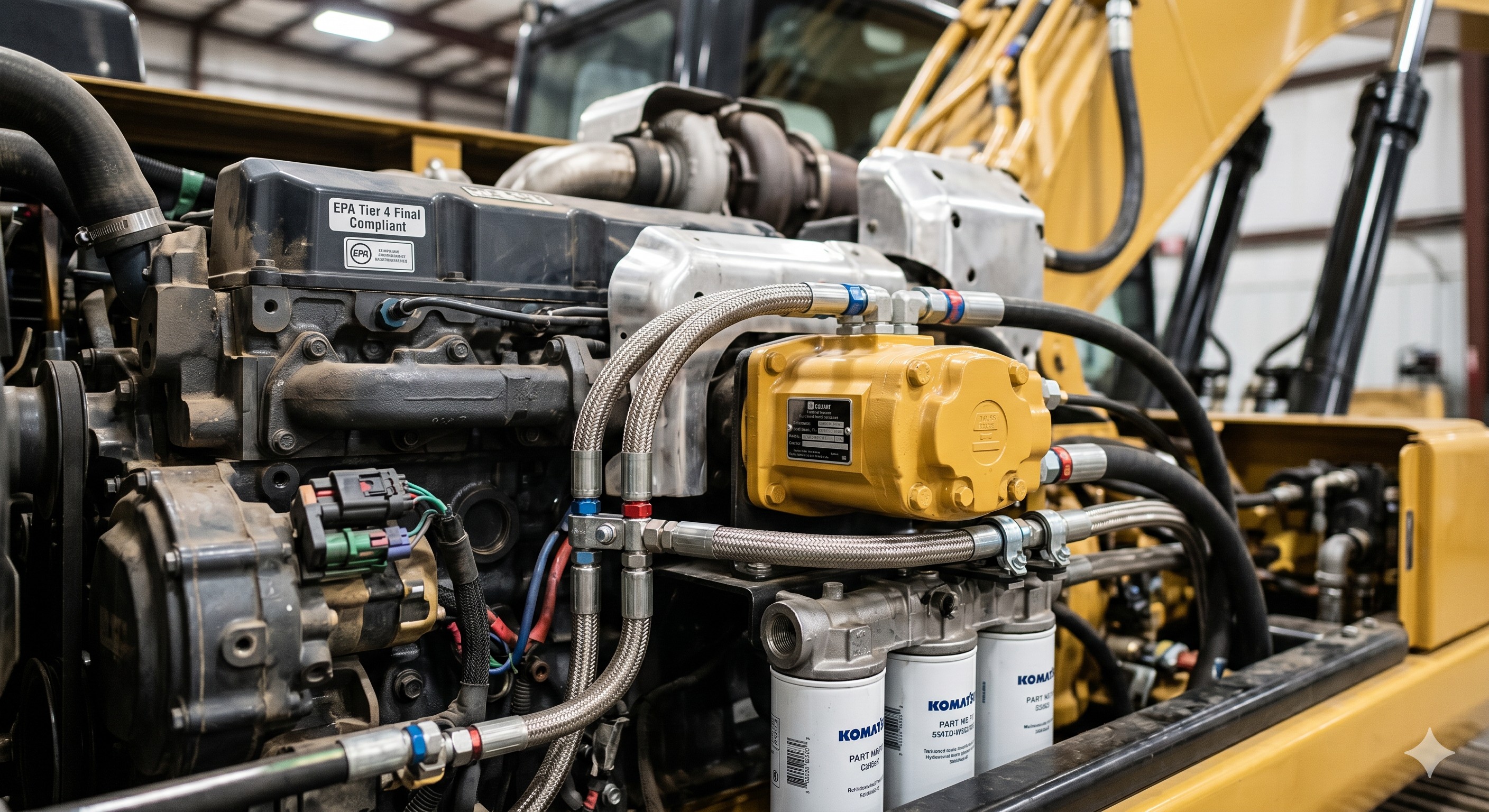
At the heart of an EPA certified excavator lies a high-pressure common rail diesel engine with exhaust gas recirculation (EGR), diesel oxidation catalyst (DOC), diesel particulate filter (DPF), and selective catalytic reduction (SCR) with diesel exhaust fluid (DEF). Typical power ratings: 150–500 hp depending on weight class. The engine control unit (ECU) manages real-time balancing of combustion temperature and DEF injection to maintain NOx below 0.2 g/bhp-hr and particulate matter under 0.01 g/bhp-hr. Despite added components, net peak torque remains within 95–98% of non-certified engines due to optimized turbocharging and variable valve timing.

Hydraulic System & Efficiency Metrics

Closed-center, load-sensing hydraulic systems with independent metering valves (IMV) are standard. Operating pressures range from 4,500 to 5,500 psi with total pump flow up to 2×200 L/min on 30-ton class machines. Electronic positive flow control reduces parasitic losses: typical hydraulic efficiency exceeds 85%. Swing circuit pressure relief at 3,800–4,200 psi, travel circuit at 5,000 psi. Cycle times for 180-degree swing and dump: 8–12 seconds depending on boom geometry.

Chassis & Undercarriage Durability

ISO 10265 certified ROPS/FOPS cabins with viscous damped mounts. Track frames are fabricated from BR400/500 grade steel with lifetime-lubricated sealed rollers and carrier rollers. Track shoe width options: 24–36 inches for ground pressure as low as 5.8 psi. Swing bearing with induction-hardened raceways achieves 8,000–12,000 hours mean time between failures under heavy-duty cycles.

Technical Specifications

The following parameters represent a typical 30-metric ton EPA certified excavator (e.g., 300 class). Actual values vary by OEM and configuration.

Key Parameter Technical Specification (30-ton class EPA Tier 4)
Engine Horsepower (net) 210 HP (157 kW) @ 2,000 rpm
Operating Weight 30,200 – 32,500 kg (66,600 – 71,650 lb)
Bucket Capacity (SAE heaped) 1.5 – 1.8 m³ (1.96 – 2.35 yd³)
Max Hydraulic Pressure (implement) 5,076 psi (350 bar)
Hydraulic Flow (total) 2 x 210 L/min (55.5 gal/min)
Swing Speed 10.5 rpm
Travel Speed (high/low) 5.3 / 3.2 km/h (3.3 / 2.0 mph)
Ground Pressure (standard shoe) 6.2 psi (42.8 kPa)
Fuel Tank Capacity 520 L (137 gal)
DEF Tank Capacity 45 L (11.9 gal)
Emissions Standard EPA Tier 4 Final / EU Stage V
Average Fuel Consumption (mixed cycle) 5.1 gal/hr (19.3 L/hr)

Comparative Advantage: TCO, Fuel Efficiency, and ROI

When evaluating an EPA certified excavator against non-certified or lower-tier alternatives, three metrics dominate: fuel cost, DEF consumption, and maintenance intervals. Field data from 2,000-hour annual operations:

  • Fuel efficiency: Tier 4 Final machines average 4.5–5.2 gal/hr (20–22 tons class) vs. Tier 3 at 5.5–6.2 gal/hr12–18% reduction.
  • DEF consumption: Approximately 2–3% of fuel volume, adding $0.30–0.50 per operating hour — offset by fuel savings of $3–4 per hour (diesel at $4/gal).
  • Maintenance: Extended oil and filter changes to 500 hours (vs. 250 on Tier 3). DPF ash cleaning at 5,000–8,000 hours, typically $1,200–$2,000 per event.
  • Resale value: EPA certified machines retain 15–20% higher value in regulated markets (California, EU, Canada).

ROI example: Over 10,000 hours, fuel savings alone reach $30,000–$40,000 versus Tier 3, outweighing added DEF and aftercare costs by >2:1.

Heavy-Duty Application Scenarios

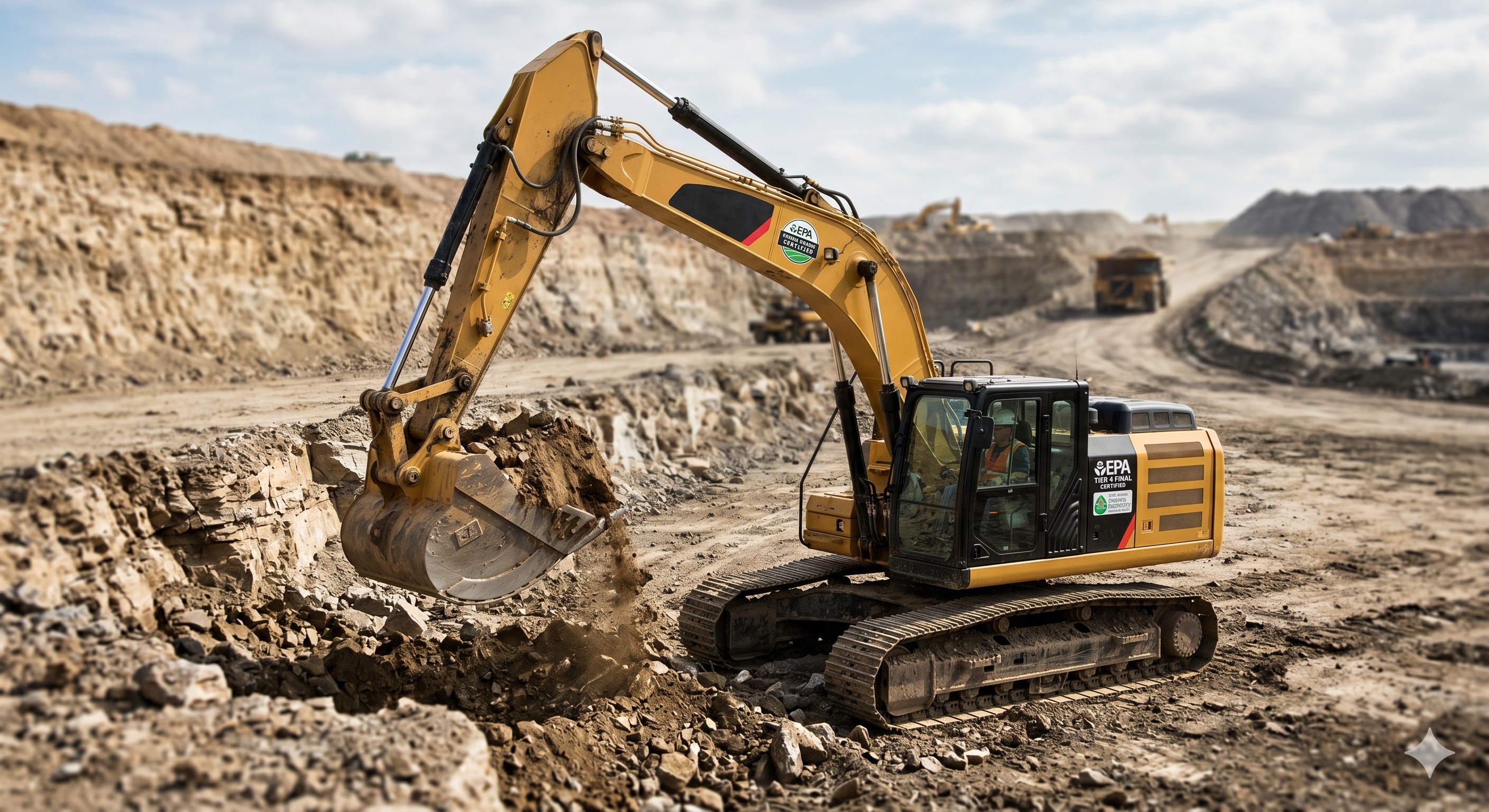
The EPA certified excavator excels across demanding environments due to its precise emissions control and thermal management systems.

  • Urban Construction & Earthmoving: Low noise (as low as 101 dBA) and near-zero smoke enable night work and near hospitals/schools. Automatic idle shutdown and eco-mode reduce site emissions.
  • Quarry & Mining: High-altitude (up to 4,500 m) and extreme temperature (-20°C to 50°C) capability with cold-start assistance and optional high-ambient cooling packages. Track tension monitoring and rock guards standard.
  • Demolition & Recycling: Pulse filter cleaning for dusty environments, plus rotating grapple/vibration shear circuits with flow rates to 400 L/min at 5,000 psi.
  • Manufacturing & Material Handling: Magnet-ready generator and boom-mounted camera systems for precision loading of scrap or bulk materials.

Conclusion: Investing in Industrial Productivity

The transition to EPA certified excavators is not merely compliance—it is an operational upgrade. Lower fuel burn, extended service life, higher resale value, and consistent power delivery under load make these machines the rational choice for any serious fleet owner. As emissions standards tighten globally (e.g., EPA Tier 5 anticipated post-2028), current Tier 4 equipment will remain compliant and tradeable for a decade. For contractors balancing profit margins with environmental responsibility, the data is clear: specify EPA certification on your next excavator purchase.

RFQ