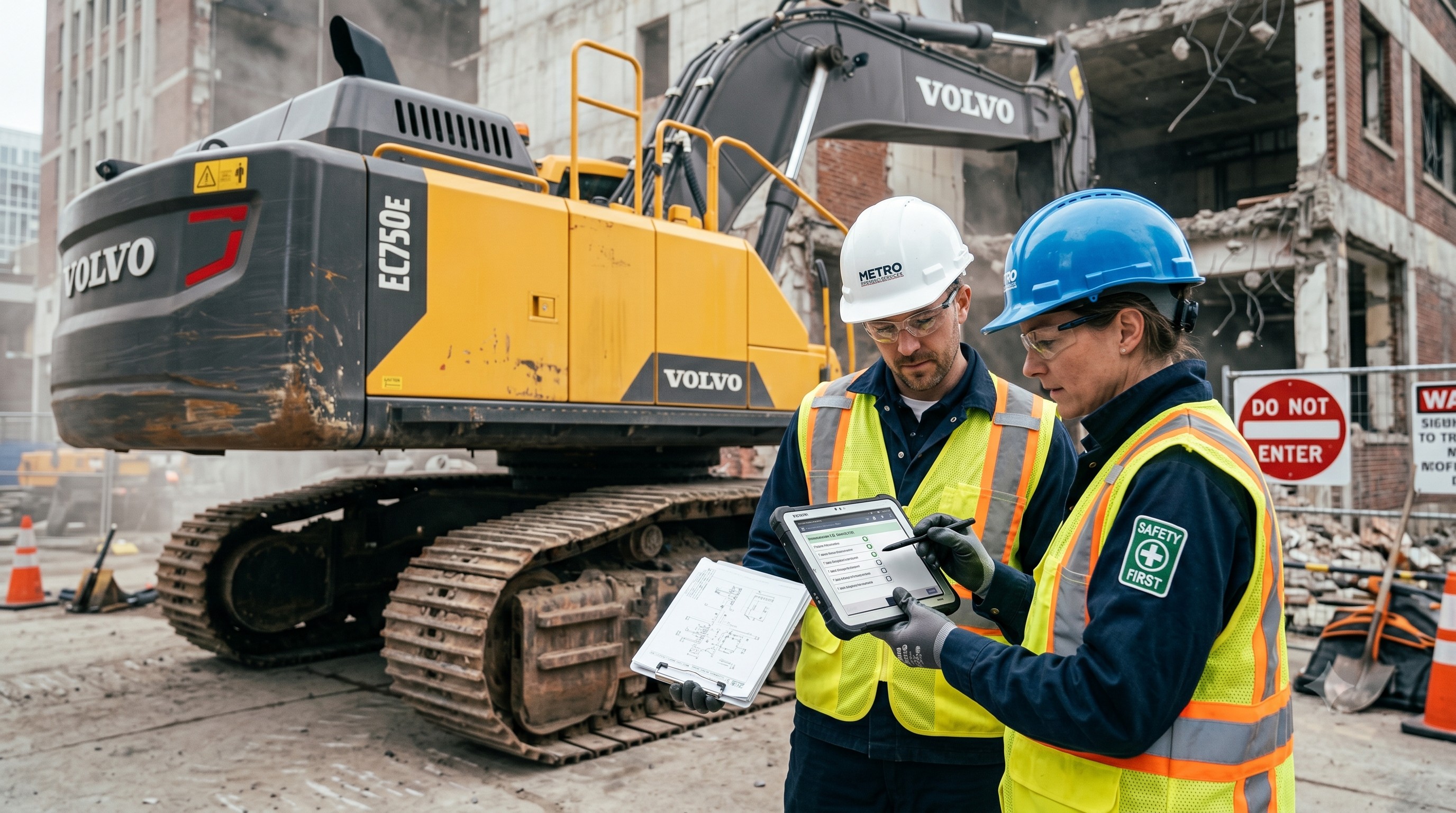
Selecting the safest demolition excavator for urban environments requires careful evaluation of advanced safety systems, emissions compliance, and machine stability. This FAQ addresses critical pre-sales and post-sales questions for B2B fleet and procurement managers, focusing on models like the Cat 330 UHD and Develon DX140RDM-7 that are engineered for the unique challenges of inner-city demolition.

The Cat 330 UHD is one of the safest choices for urban demolition due to its integrated stability monitoring, 2D E-Fence system, and a TOPS-rated tilting cab with P5A high-resistance glass and operator protective guards (OPG) . Its stability monitoring system displays real-time data on the machine's swing angle and front position via a 10-inch in-cab touchscreen, helping prevent tip-overs . Furthermore, the Cat 2D E-Fence technology keeps the front linkage within a predefined work area, protecting the machine and enhancing site safety .
Essential safety features for urban demolition excavators include a stability warning system, a 360-degree all-around view camera (AVM) with ultrasonic detection, and falling object protective structures (FOPS) . The Develon DX140RDM-7, for example, offers a 360° AVM linked to ultrasonic detection for maximum visibility in tight spaces . A TOPS-rated tilting cab, like that on the Cat 330 UHD, improves visibility and operator ergonomics while providing critical protection from falling debris . Remote-control readiness is also a key feature for keeping operators out of the danger zone .
Engine emissions compliance is critical for urban demolition, as many cities have strict regulations to reduce pollution . For instance, the Cat 330 UHD is powered by a Cat C7.1 engine that meets US Tier 4 Final, EU Stage V, and Japan 2014 emission standards, making it suitable for environmentally regulated areas . Volvo CE also offers electric demolition machines that produce zero operational exhaust emissions for noise and emission-sensitive urban projects . Selecting a compliant machine ensures you can work in restricted zones without facing fines or project delays.
The maximum pin height and compatible attachment weight vary by model, but modern high-reach excavators can handle heavy tools at significant heights. The Cat 330 UHD can carry a 3,300 kg (7,275 lb) demolition tool at a maximum pin height of 20 meters (65 feet 6 inches), making it capable of 5-to-6-story work . For even greater reach, the Volvo EC380DL UHR offers a 23.0-meter reach, demonstrating the range available for specialized high-reach applications .
The standard daily maintenance routine for a demolition excavator involves pre-start walk-around checks and in-cab inspections to ensure safety and reliability . Daily tasks should include checking engine and hydraulic oil, coolant levels, water separators, and drains, all of which are designed to be accessible at ground level on modern machines like the Cat 330 UHD . A thorough visual inspection for leaks, track integrity, and mirror/lights functionality is mandatory before each shift to identify potential issues early .
When changing attachments, operators must follow strict safety protocols, including using a quick coupler with fully engaged locking latches and ensuring hydraulic pressure is released before disconnecting lines to prevent injury . For fully automatic quick hitch couplers, it is vital to apply full hydraulic pressure to the coupler's locking system and visually confirm that the attachment is secure . When manual assistance is required, assistants must keep their limbs clear of pinch points during pin alignment to prevent crushing injuries .
A variable undercarriage enhances stability by allowing the operator to widen the track gauge to provide a more stable base during high-reach demolition or heavy lifting . The Develon DX140RDM-7 offers a variable undercarriage width of 2540 to 3740 mm . This is crucial in urban environments where space is confined, allowing the machine to navigate narrow streets while maximizing stability when needed . A wider stance reduces the risk of tipping, which is a primary safety concern when working at height or on uneven ground.
Critical hydraulic system maintenance includes daily visual inspections for leaks, ensuring hydraulic oil lines are not snagged or damaged, and monitoring hydraulic oil levels . It is essential to check for any signs of wear or damage to hoses, as failure can lead to sudden loss of oil and control. Following the manufacturer's recommended schedule for hydraulic fluid and filter replacement is key to preventing component failure and ensuring reliable operation. When disconnecting hydraulic lines for maintenance, always follow procedures to relieve residual high pressure to avoid serious injury from oil injection .