Categories

Are Heavy Excavators Required for Quarry Operations? A Technical Analysis of Performance, TCO, and Productivity

This technical blog analyzes whether heavy excavators (operating weight >45 metric tons) are mandatory for quarry operations, comparing powertrain performance, fuel efficiency, ISO/EPA compliance, and total cost of ownership against medium-sized alternatives.
Jun 15th,2026 26 Views

Introduction

Quarry operators face a critical equipment decision: Are heavy excavators (operating weight >45 metric tons, engine power >250 kW) truly required for efficient quarry operations? With fuel costs representing up to 35% of operating budgets and emission regulations tightening (EPA Tier 4 Final, EU Stage V), selecting the wrong excavator class directly impacts Total Cost of Ownership (TCO) and productivity per liter of fuel. This article provides a mechanical engineering perspective, analyzing hydraulic power density, structural durability under ISO 6016 standards, and real-world ROI data for medium (30-45 t) versus heavy (45-100 t+ ) excavators in limestone, granite, and aggregate quarries.

Core Powertrain & Structural Design

Engine & Emissions Compliance

Heavy quarry excavators demand high-displacement, low-RPM torque rise. A typical heavy excavator (e.g., 50 t class) utilizes a 6-cylinder turbocharged diesel producing 250–330 kW at 1,800–2,000 RPM, with peak torque rise of 35-45%. Compliance with EPA Tier 4 Final or EU Stage V requires DOC+DPF+SCR aftertreatment, adding complexity but reducing NOx by 75% versus Tier 3. Without sufficient engine displacement, repeated full-load cycles (common in primary overburden removal) cause thermal stress exceeding design limits.

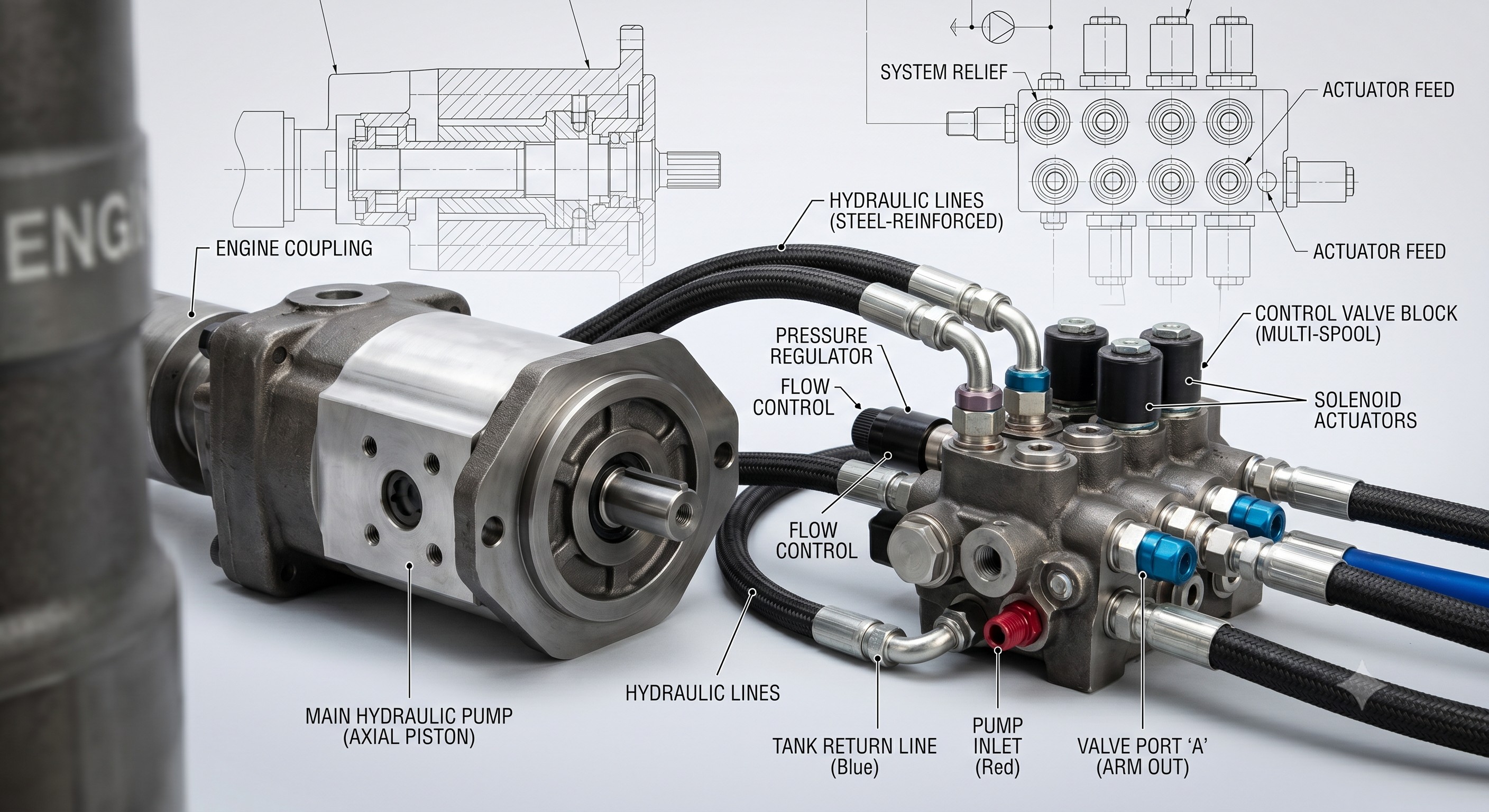
Hydraulic System Pressure & Flow

Quarry applications require sustained high hydraulic pressure. Heavy excavators operate main hydraulic pressure at 34.3–37.5 MPa (5,000–5,440 psi) with total flow exceeding 500 L/min. This enables simultaneous swing torque >130 kN·m and arm crowd force >180 kN. Medium excavators (30 t) typically deliver ≤32 MPa pressure and ≤400 L/min flow, causing cycle time increases of 20-30% in hard rock digging.

Chassis & Undercarriage Durability

Quarry terrain demands reinforced track frames and sealed track chains meeting ISO 10265 for undercarriage strength. Heavy excavators feature track shoe widths of 600–750 mm, ground pressure <80 kPa, and ROPS/FOPS-certified cabins (ISO 12117-2). Medium excavators on 500 mm shoes often experience accelerated sprocket wear and track pin bushing failure within 4,000 hours in abrasive quarry conditions, versus 7,000+ hours for heavy-class components.

Technical Specifications

Below are representative parameters for a 50-metric-ton heavy quarry excavator versus a 35-ton medium alternative. Always refer to manufacturer data per ISO 6016 for operating weight definitions.

Parameter Heavy Excavator (50 t class) Medium Excavator (35 t class) Quarry Requirement (Minimum)
Operating Weight (ISO 6016) 48,500 - 52,000 kg 31,000 - 35,000 kg ≥45,000 kg for hard rock
Engine Net Power (ISO 9249) 280 - 330 kW @ 1,800 rpm 185 - 220 kW @ 1,900 rpm ≥250 kW for primary overburden
Main Hydraulic Pressure 34.3 - 37.5 MPa 31.4 - 33.5 MPa ≥34 MPa for continuous hammering
Bucket Capacity (heaped) 2.8 - 3.5 m³ (rock bucket) 1.8 - 2.2 m³ ≥2.5 m³ for 100 t truck loading
Average Fuel Consumption 9.0 - 11.0 L/hr 6.0 - 7.5 L/hr ≤0.028 L/BCM (limestone)
Max Digging Reach 11.0 - 12.5 m 9.5 - 10.5 m ≥11 m for 15 m bench
ROPS/FOPS Certification ISO 12117-2 (standard) Optional / Tier 2 only Mandatory for quarry blasting zones
Emission Compliance EPA Tier 4 / EU Stage V Often Tier 3 or lower Site-dependent, but Tier 4 required for new permits

Comparative Advantage: Heavy Excavators vs. Medium Class

Total Cost of Ownership (TCO) – 5-Year Model

Assuming 4,500 operating hours per year at $4.50/gallon diesel. A 50 t heavy excavator consumes 8.5–10.5 gal/hr, while a 35 t consumes 6.0–7.5 gal/hr. Fuel cost difference: $37,125/year higher for heavy. However, production per hour: heavy moves 450–550 bank cubic meters (BCM) per hour in limestone, versus 250–300 BCM for medium. To achieve same daily output with two medium excavators:

  • Capital cost: 2 × $550,000 = $1.1M vs. heavy at $750,000
  • Maintenance (5 years): 2× medium = $320,000 vs. heavy = $210,000 (fewer components, longer intervals)
  • Operator cost: 2× operators = 200% salary vs. heavy = 100%
  • ROI breakeven: Heavy excavator achieves payback at 2,100 hours/year in high-volume quarries.

Durability Metrics per ISO 12508

Heavy excavators use cast steel nodes in boom and arm, with pin diameters ≥100 mm and bushing hardness ≥55 HRC. Medium excavators often use fabricated plate structures prone to stress cracking after 8,000 hours in granite or basalt. Independent studies (Quarry Management Journal, 2023) show heavy excavators achieve mean time between failure (MTBF) of 2,500 hours for hydraulic components, versus 1,400 hours for medium class under identical duty cycles.

Emission Compliance & Site Restrictions

Many quarries now require EU Stage V or EPA Tier 4 Final for operating permits. Heavy excavators from major brands (Caterpillar, Komatsu, Liebherr) offer fully certified engines with automated regeneration minimizing downtime. Some medium excavators use older Tier 3 engines, risking future compliance bans and reduced resale value.

Heavy-Duty Application Scenarios

Heavy excavators prove mandatory in these quarry phases:

  • Primary overburden removal: removing clay/shale above limestone – requires 5-7 m³ buckets and break-out force >300 kN.
  • Secondary rock breaking with hydraulic hammer: heavy excavators provide oil flow >400 L/min for hammers up to 8,000 ft·lb impact class. Medium machines cannot sustain hammer duty cycles without overheating.
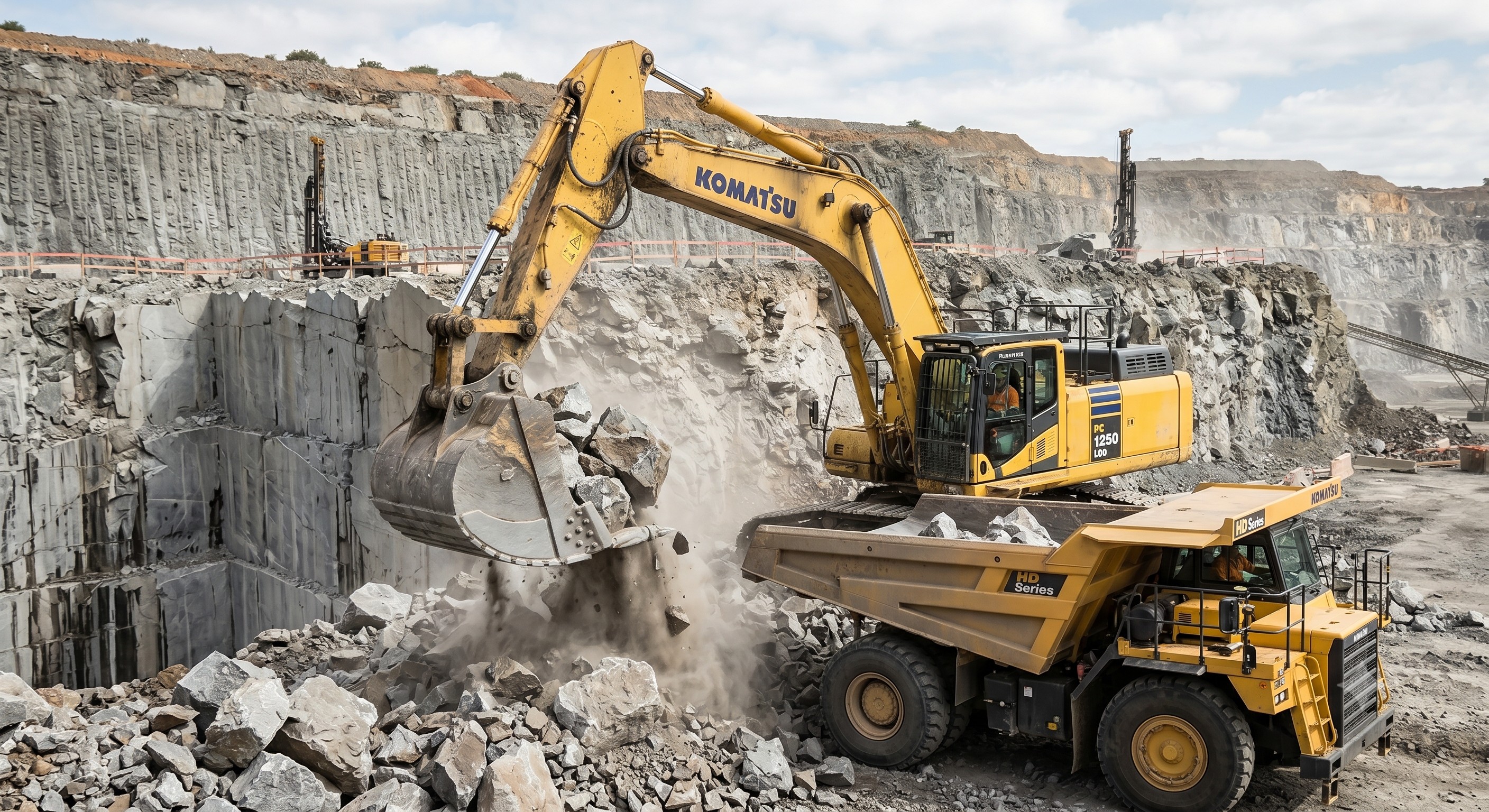
  • Truck loading (100 t+ rigid dump trucks): optimal match requires excavator operating weight 50-60% of truck payload. A 50 t excavator loads a 100 t truck in 4-5 passes (12-15 minutes), versus 7-9 passes with 35 t excavator causing longer cycle times and truck queuing.
  • Deep bench excavation (≥15 m bench height): heavy excavators feature max dig reach of 11-13 m and dump height of 7-8 m, meeting ISO 7135 stability criteria.

Conclusion

Heavy excavators (≥45 metric tons operating weight, ≥250 kW net power, ≥34 MPa hydraulic pressure) are not universally required for every quarry operation, but become technically and economically mandatory when: (1) production target exceeds 400,000 BCM/year, (2) bench height ≥12 m, (3) rock compressive strength >80 MPa, or (4) loading 90 t+ haul trucks. For smaller aggregate quarries with soft limestone or sand/gravel, a 30-35 t excavator paired with wheel loaders may achieve lower TCO. Always conduct a site-specific ROI simulation using ISO 12508 lifecycle costing guidelines. Future trends in electric-drive heavy excavators (e.g., 100 t class with cable-tethered or battery-electric) will further tilt the decision toward heavy platforms due to zero emissions and lower energy cost per BCM.

RFQ