Categories

Why Choose a Compact Excavator for Agriculture? | Heavy Machinery SEO

Discover the technical and economic advantages of compact excavators in agriculture. This article covers powertrain design, specs, ROI, and applications.
Jun 23rd,2026 8 Views

Introduction: Addressing Modern Agricultural Challenges with Precision Engineering

Modern agriculture faces a confluence of pressures: tighter profit margins, labor shortages, and the need for sustainable, efficient land management. Traditional heavy machinery often proves too bulky for specialized tasks, damaging soil structure and failing to navigate confined livestock areas or delicate orchards. The compact excavator for agriculture has emerged not merely as a tool, but as a strategic asset, offering the perfect balance of power and precision . These machines are engineered to tackle everything from intricate trenching for irrigation systems to heavy-duty demolition of old silos, providing a versatile solution that directly addresses the modern farmer's pain points. By integrating advanced hydraulic systems, robust powertrains, and adherence to stringent emission standards, compact excavators deliver a return on investment that is measurable in both productivity and fuel savings.

Core Powertrain & Structural Design: Engineered for Endurance

The superiority of a modern compact excavator lies in its integrated powertrain and structural design, purpose-built for the harsh demands of the agricultural environment.

Engine & Emission Compliance

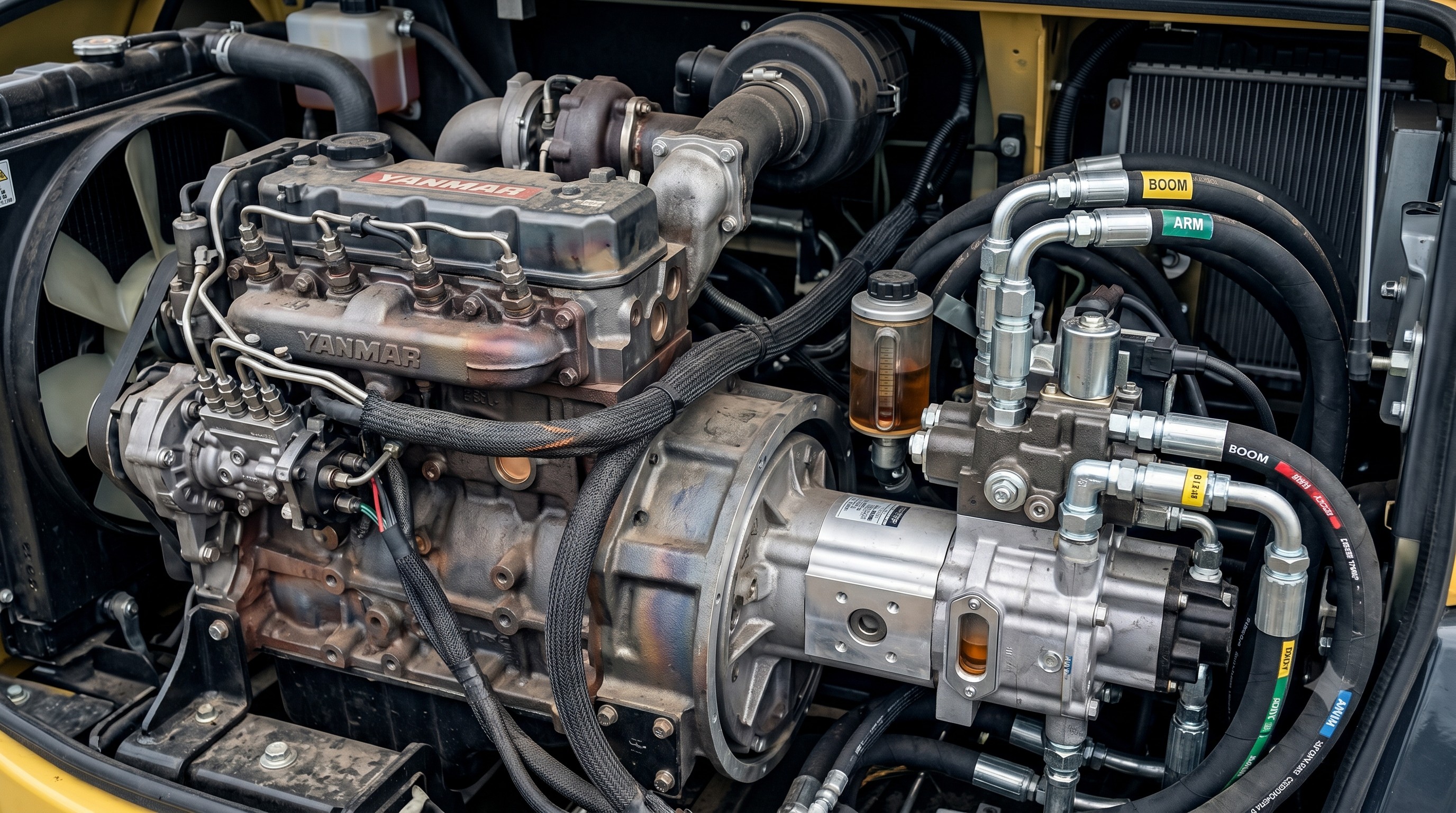
At the heart of these machines are high-torque diesel engines designed for longevity. Many new models, such as the New Holland D-Series, are powered by FPT (Fiat Powertrain Technologies) engines that comply with EPA Tier 4 Final and EU Stage V emission standards . This compliance is critical for farm sustainability goals and operational legality. For example, the New Holland E50D boasts an operating weight of 10,912 lbs and an engine that integrates fuel-saving features like Eco Mode and Auto Idle, significantly reducing unnecessary fuel burn during less demanding tasks .

Advanced Hydraulic Systems

Hydraulic power is the lifeblood of agricultural excavation. The latest machines feature closed-center hydraulic systems with load-sensing pumps, such as those found on the new Bobcat E17 and E20 models, which provide smooth, responsive control and precise positioning for delicate tasks around existing structures . This is a significant upgrade from standard open-center systems, allowing for multi-functioning capabilities without compromising force. Furthermore, the ability to handle high auxiliary hydraulic flow expands versatility; for instance, the Volvo EC65 and EW65 models see a 100% increase in auxiliary hydraulic flow, empowering them to run demanding attachments like augers and mulchers with ease .

Chassis Durability & Maneuverability

Agricultural work often means navigating mud, uneven terrain, and tight spaces. Durable undercarriages with choices between rubber tracks (for turf protection) and steel tracks (for abrasive, rocky conditions) provide essential adaptability . Models featuring zero-tail-swing and retractable undercarriages, like the Bobcat E17 that can retract from 53.5 inches to just 38.6 inches, allow for unparalleled maneuverability in confined livestock pens and narrow vineyard rows .

Technical Specifications: A Data-Driven Overview

Understanding the technical parameters is crucial for selecting the right implement. The following table compares key specifications across leading models to illustrate the range of capabilities available for modern farming operations. These figures, including operating weight, engine horsepower, and breakout force, adhere to industry-standard measurement protocols (e.g., ISO 6015 for breakout force).

Key Parameter Volvo ECR90 New Holland E50D New Holland E70D Bobcat E17
Engine Net Power (hp/kW) 60 / 45 72 / 53 Data not available Data not available
Engine Gross Power (hp/kW) 73 / 54 72 / 53 Data not available Data not available
Operating Weight (lbs/kg) 19,340 - 23,170 / 8,770 - 10,510 10,912 / 4,950 16,072 / 7,290 Data not available
Max. Dig Depth (in/mm) Data not available 131 in / 3,327 mm 168.1 in / 4,270 mm Data not available
Bucket Breakout Force (lbf/kN) 5,824 / 57 9,667 / 43.0 Data not available Data not available
Max. Travel Speed (mph) 3.1 2.8 Data not available Data not available

Comparative Advantage: TCO, Fuel Efficiency, and ROI Analysis

When evaluating capital expenditure, the conversation must center on total cost of ownership (TCO) and operational efficiency compared to alternatives like traditional backhoe loaders or skid steers.

Fuel Efficiency & Operating Costs

Fuel is a primary operating cost, and compact excavators demonstrate a distinct advantage. Data indicates that a 3.5-ton class compact excavator burns between 1.2 to 2.0 gallons per hour (gph), while a higher-horsepower mini-skid steer can consume 1.5 to 3.5 gph under comparable loads . This translates to approximately $1,400 annually in fuel costs for a compact excavator versus $2,200 for a mini-skid steer at 700 operating hours, yielding significant savings .

Total Cost of Ownership (TCO)

While a mini-skid steer may have a lower sticker price, the excavator’s lower fuel burn, strong resale value, and reduced maintenance costs level the playing field. Over a 5-year period at 700 hours per year, the net cost-per-hour for a compact excavator is estimated at $12.14 versus $12.86 for a mini-skid steer . Additionally, extended service intervals—such as Volvo CE's 8,000-hour DPF cleaning cycle—minimize downtime and maintenance expenses .

Productivity & Versatility

For tasks requiring significant digging, trenching, or demolition, a compact excavator is inherently more productive than a tractor or skid steer . Its 360-degree rotation and precise boom control allow operators to complete complex tasks without repositioning the machine, saving time and reducing soil compaction. Using a compact excavator and skid steer combination on a jobsite often allows work to be completed in half the time compared to relying on a single backhoe, as two specialized machines can operate simultaneously on grading and digging tasks .

Heavy-Duty Application Scenarios in Agriculture

The versatility of the compact excavator makes it indispensable across a wide array of agricultural scenarios, often replacing more cumbersome equipment.

  • Livestock and Dairy Operations: These machines are used for heavy-duty cleaning of manure lagoons and feedlot pens, and for digging post holes for fencing. The retractable undercarriage allows for excellent maneuverability inside barns and alleyways .
  • Orchards and Vineyards: In tight rows, the zero-tail-swing and precision hydraulic control allow for efficient planting, installing trellis systems, and maintaining drainage without damaging root systems or tree trunks .
  • Drainage and Irrigation: For farmers looking to improve water management, the high breakout force (e.g., 9,667 lbf on the New Holland E50D) and deep digging depths enable efficient trenching for subsurface drainage and irrigation lines .
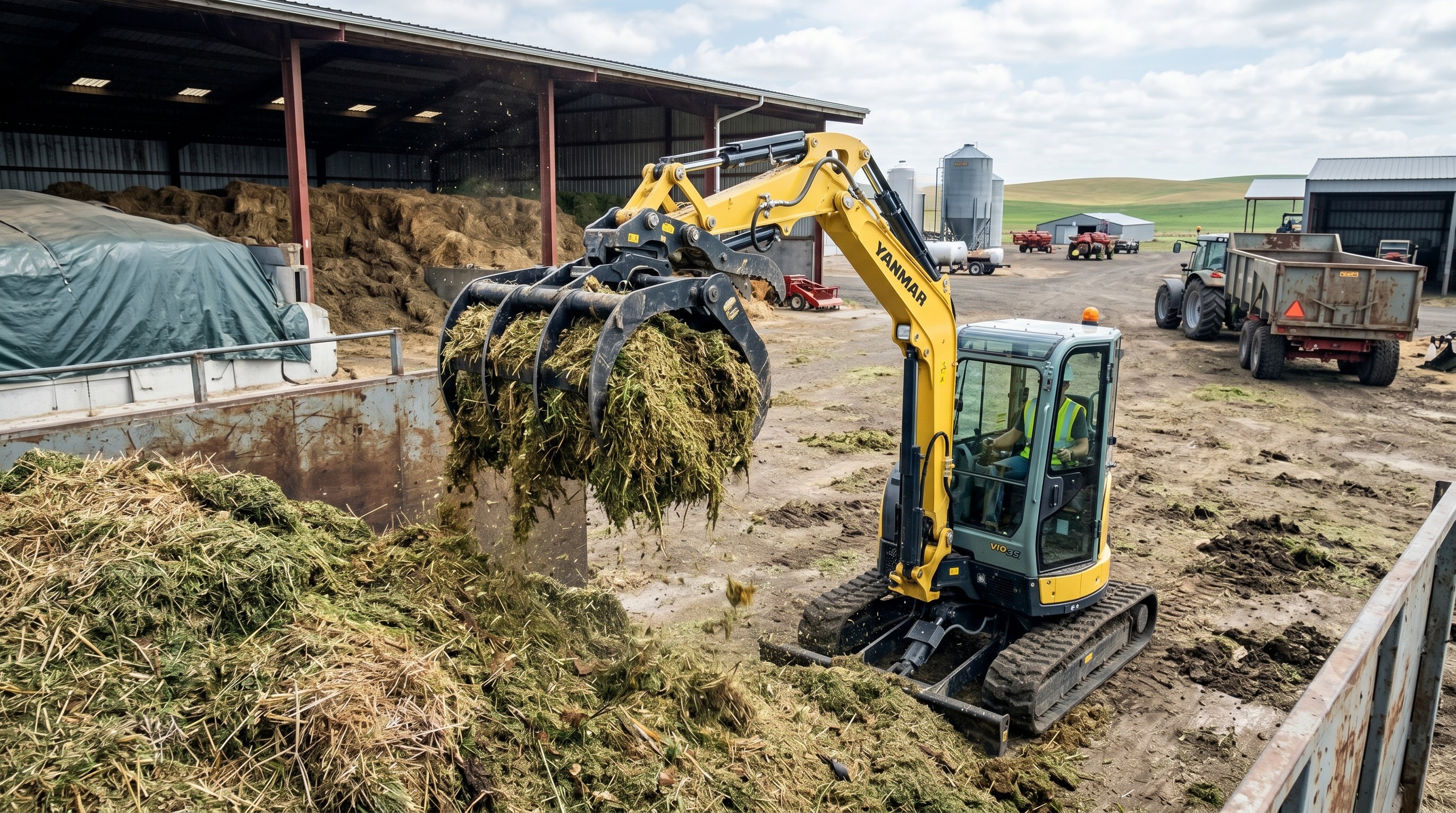
  • Grain and Silage Handling: Equipped with specialized grapples and buckets, these excavators aid in managing and compacting silage piles, as well as loading and moving bulk materials within tight storage areas.
  • Demolition and Renovation: When aging farm infrastructure needs renovation or removal, the ability to handle hammers and shears makes the compact excavator an essential demolition tool, far more efficient than a tractor loader .

Conclusion: The Future of Agricultural Productivity

Integrating a compact excavator for agriculture is a strategic decision rooted in engineering excellence and economic foresight. By delivering the perfect synergy of power, precision, and efficiency, these machines are redefining productivity benchmarks. They offer a lower total cost of ownership, superior fuel economy compared to larger alternatives, and the agility to perform a vast array of tasks. As the agricultural sector continues to evolve toward greater mechanization and sustainability, investing in advanced, multi-purpose compact equipment is not just an option—it is a necessity for competitive, forward-thinking operations.

RFQ